top of page

Your PSOAS Muscle: understanding a source of deep-seated tension
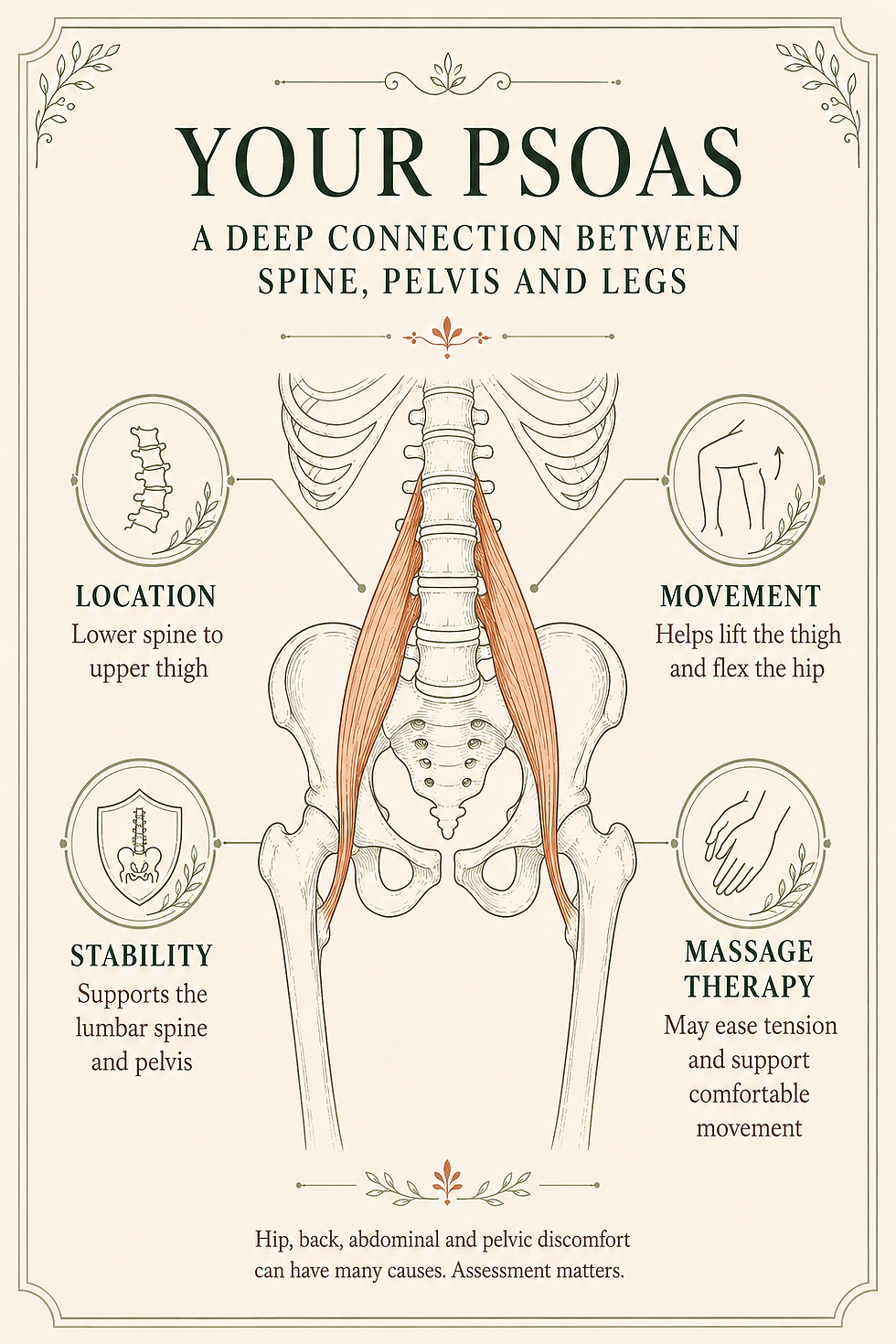
What Is the Psoas?
The psoas is a deep muscle that connects the lower spine to the upper thigh. It travels through the pelvis and joins another muscle, the iliacus, to form the iliopsoas.
This location gives the psoas an important role in connecting the upper and lower body. It helps lift the thigh, move the hip and support stability through the lumbar spine and pelvis. You use it when walking, climbing stairs, rising from a chair and bringing your leg forward.
Despite its reputation, the psoas is not a mysterious muscle—and it is not responsible for every ache in the hips or lower back. It works as one part of a larger system that includes the abdominal muscles, gluteals, quadriceps, other hip muscles, joints, connective tissues and nerves.
Why Can the Psoas Feel Tense?
The psoas is active during many everyday positions and movements. Changes in activity, repetitive movement, prolonged sitting, injury and protective muscle guarding may all influence how the area feels and functions.
The word “tight” is often used to describe the psoas, but it does not tell us exactly what is happening. A muscle may feel tense because it is shortened, sensitive, overworked, weak or responding protectively to discomfort elsewhere.
This is why assessment matters. Stretching or applying deep pressure is not automatically the right answer for every person experiencing hip or lower-back tension
.
What Might Psoas-Related Discomfort Feel Like?
When the psoas or nearby tissues contribute to discomfort, sensations may be felt through the front of the hip, groin, lower abdomen or lower back. Some people notice stiffness after sitting, discomfort when standing fully upright or difficulty extending the hip comfortably.
These symptoms are not unique to the psoas. Several muscles, joints, nerves and abdominal or pelvic structures can produce similar sensations. New, severe or persistent pain should therefore be appropriately assessed rather than assumed to come from a tight muscle.
Does the Psoas Store Stress?
The psoas is sometimes called the “muscle of the soul” and is frequently described online as storing stress or emotional trauma. These claims are not supported as established anatomical facts.
Stress can influence breathing, posture, movement and muscular tension throughout the body. It may also affect how guarded or sensitive a person feels. However, trauma is not physically stored inside one particular muscle.
The psoas is important because of its location and role in movement—not because it holds a hidden emotional meaning.
How Can Massage Therapy Help?
Massage therapy may help address muscular tension, sensitivity and uncomfortable movement involving the hips and lower back. Treatment may include the psoas when your assessment suggests that it is appropriate, but direct psoas treatment is not always necessary.
A broader approach may involve the iliacus, quadriceps, inner-thigh muscles, gluteals, abdominal wall and muscles of the lower back. Myofascial techniques, gentle movement and appropriate home-care recommendations may also be incorporated.
Research specifically examining psoas massage remains limited. Some studies suggest that manual or myofascial techniques may provide short-term improvements in pain or movement for certain people, but massage cannot permanently lengthen the psoas, push it back into place or guarantee a dramatic “release.”
The purpose of treatment is not to force change. It is to work thoughtfully with the muscles and surrounding tissues to support greater comfort and easier movement.
What Does Psoas Treatment Feel Like?
Because the psoas lies deep within the abdomen and pelvis, treatment should never involve forcefully pressing through the body in an attempt to reach it.
When direct treatment is appropriate, pressure is introduced slowly and remains within your comfort. You may feel gentle, sustained contact through the abdomen or front of the hip. You should be able to breathe comfortably, and the treatment should not feel sharp, invasive or overwhelming.
The proposed treatment, positioning, draping, expected benefits, risks and alternatives will be explained beforehand. Written consent will be obtained whenever treatment involves a designated sensitive area. You may ask questions, change your mind or request that treatment be modified or stopped at any time.
Direct psoas treatment is always optional. Effective treatment for hip and lower-back discomfort can also be provided without contact through the abdomen or upper inner thigh.
A Thoughtful Approach to Deep Tension
At Solace, the psoas is considered as one part of the whole person. Sometimes it may benefit from focused treatment. At other times, the most useful approach may involve neighbouring muscles, movement, strengthening or referral to another healthcare professional.
The goal is not to chase an intense or dramatic release. It is to provide safe, responsive care that helps you feel more comfortable and confident in the way your body moves.
bottom of page